| Recent Comments |
| Categories |
| Archives |
| Tags |
The physics and mathematics of sound (Saterday, 17 July, 2021)
It has been a while since my last post but I was busy renewing my (basic) understanding about sound.
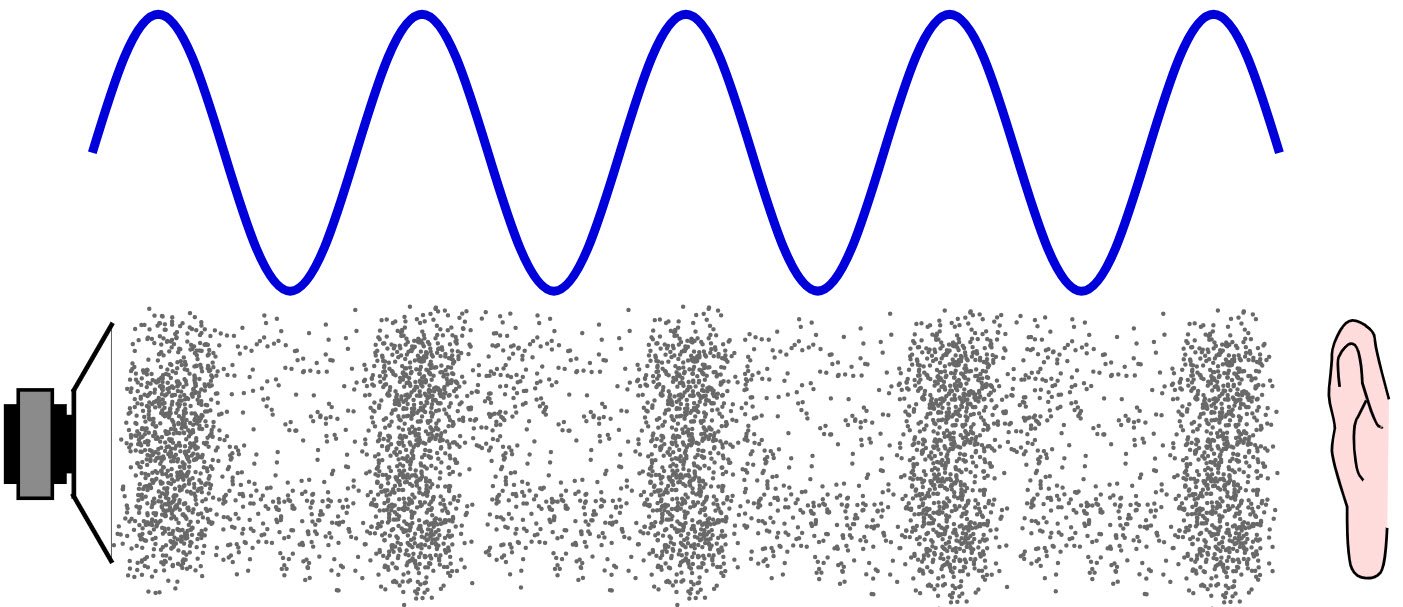
Figure from Wikimedia.
If you work with digital audio workstations (DAWs) like Cubase, or use other audio software then it almost impossible to miss terminology like ‘decibels’ as a measure for sound level. Also your TV or hifi amplifier may show volume in (negative) dBs. Looking for more information you come across equations the next one to express sound pressure levels:
![\[ L_{SPL} = 20 log_{10} \left( \frac{p}{p_{ref}} \right) \]](https://skippystudio.nl/wp-content/ql-cache/quicklatex.com-1f1578ff431cee3e52f7bc7f9203f1cd_l3.png "Rendered by QuickLaTeX.com")
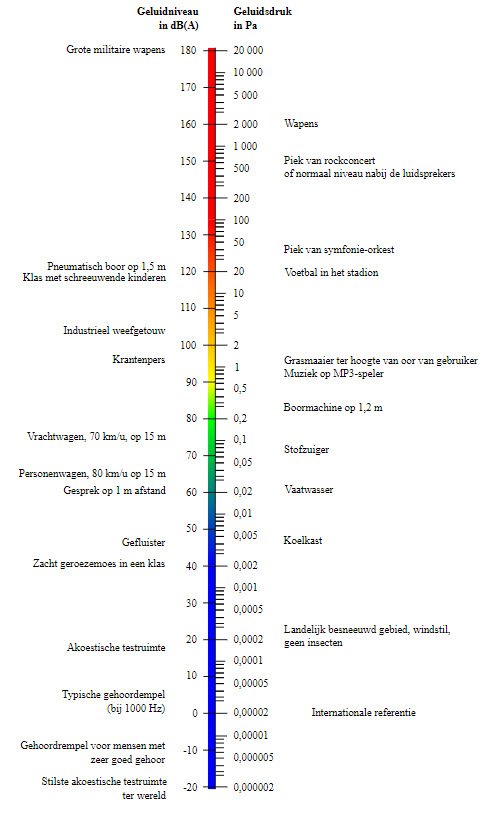
Figure from Jurgen Gaeremyn (click on figure; Wikipedia).
But where does this come from? Why is there a factor ’20’? Why does it have a logarithmic scale? And how does this physical quantity relate to audio metering in programs like Cubase which express audio levels in terms of decibel full-scale (dBFS).
To a certain extend, many of the involved concepts are intuitive and you do not need a deep understanding to use them during mixing or mastering. Thus, if you prefer, you can safely neglect the underlying physics and mathematics. However, it kept on bothering me not knowing in little more the detail the underlying principles and the derivation that results in these kind of equations, and to see how this is implemented in Cubase.
Moreover, questions related to dB(FS) frequently come up in various internet forums but I never found these very satisfying. Therefore, I decided to take some time to dig into these matters (still neglecting some details). This took some more time then I expected but resulted in two lengthy posts that together provides some background on these questions:
I have tried to put all relevant details in these two posts because one problem is that information about sound levels is scattered all over the place. Thus, I hope these posts are already useful in this sense.

While doing this I found this nice book Physics and Music which I can recommend, but also the open access book University Physics Volume 1 which proved a great resource to write these two posts. Several of the concepts I describe in my posts are based on international standards from, for example, the Audio Engineering Society. What complicated my exploration is that all the documents that describe these standards are available but not free. For example, document AES17-2020 that clarifies the definition of levels, the units of Full Scale, and dBFS is only available for 100 dollar (or after becoming a member of AES). I did not want to pay this amount of money at this time.
Anyway, hope you enjoy the posts, and feel free to comment (about errors that still may be in there). In the meanwhile I will try to finish my new song Time to Start of which a draft version is available on SoundCloud:
Let’s end today with some beatboxing by the country boys